Member Spotlight

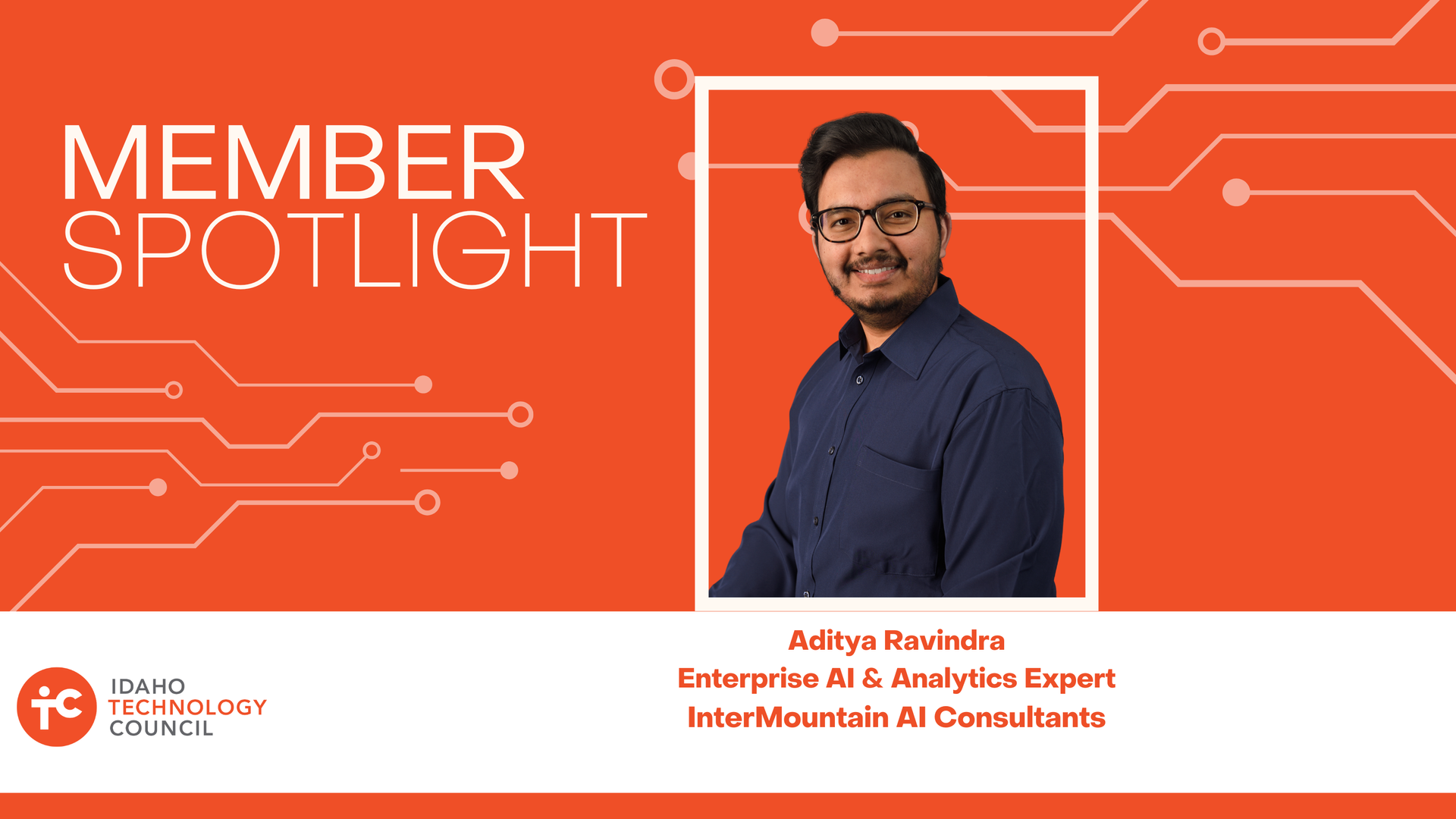
Introducing: Aditya Ravindra, Enterprise AI & Analytics Expert, InterMountain AI Consultants


Describe the business/organization you work for:

InterMountain AI Consultants helps small and medium-sized businesses transform data chaos into competitive advantages. I specialize in sifting through complex details and compiling them into actionable insights—and no, it's not as boring as it sounds. Here's a real example from this week: A local Idaho-based moving and storage company was drowning in spreadsheets, unable to see their financial picture in realtime. I built them a custom financial dashboard that consolidates revenue, expenses, and profitability metrics into live visualizations they can access from any device. Now their leadership team makes data-driven decisions in minutes instead of spending hours digging through Excel files. The dashboard transforms their raw operational data into clear insights about which services are most profitable, seasonal trends, and cash flow patterns. Simply put: data talks, I listen, and I help business leaders join the conversation.


What inspired you to start your own business, or why did you decide to work for this specific organization?

Scope and impact. I currently work as a Senior Data Consultant at a Fortune 5 healthcare company, where every day presents new challenges at enterprise scale. While pursuing my Master's in AI from UT Austin, I've found it incredibly rewarding to apply cutting-edge theories to realworld problems. However, working within a large organization often means being channeled into specific projects. I wanted to branch out—to create customized solutions across diverse industries and help regional businesses access enterprise-level AI expertise. I need variety to thrive, and consulting allows me to bring Fortune 500 methodologies to local Idaho businesses who need them most.


What sets this business apart from others in the industry?

Continuous education and cutting through the AI hype. My approach isn't just about degrees and credentials—it's about staying on the cutting edge. I regularly complete the latest training workshops, AI certifications, and technical courses to understand what's actually emerging in AI versus what's just buzzwords. This knowledge lets me guide businesses toward practical, ROI-driven solutions rather than expensive experiments. I translate complex AI capabilities into business language and help leaders understand what will actually move the needle for their specific operations. Think of me as an AI translator who speaks both data science and business outcomes.


What challenges have you faced as a business owner or employee, and how did you overcome them?

The biggest challenge is navigating client fear and skepticism around AI. Many business leaders feel overwhelmed by AI hype or worry about implementation complexity. I've turned this into my superpower—I guide clients through the noise toward what's genuinely useful for their specific needs, distinguishing practical tools from empty promises. The second challenge is the "how"—designing the optimal customized solution from thousands of possible approaches. While sometimes overwhelming, this is also the most rewarding part. Each client's unique data environment requires creative problem-solving, and finding that perfect fit between their needs and the right AI tools keeps the work engaging.


What advice would you give to someone looking to join your industry?

Three pieces of advice: First, just start. Don't wait for perfect conditions—pick a course, open your laptop, and begin. We're at the ground floor of AI, and this opportunity won't last forever. Second, embrace failure as education. Not every approach will work, but each failure teaches you what will succeed next time. The projects that work best are often built on lessons from the ones that didn't. Third, find ways to make it fun. Every job has monotonous moments, but approaching AI problems creatively keeps both learning and application enjoyable. The intersection of curiosity, persistence, and practical application is where real value emerges.


About the Idaho Technology Council
The Idaho Technology Council (ITC) is a member-based organization that champions innovation and collaboration to grow Idaho’s economy through technology. Representing a dynamic and growing community of entrepreneurs, industry leaders, and policymakers, ITC connects vision with action to position Idaho as a hub for i
nnovation and opportunity. Learn more at www.idahotechcouncil.org.


Connect with Aditya on LinkedIn HERE

Check out InterMountain AI Consultants HERE

by Tim Munkres 12 May 2026
Introducing: Nate Amidon, CEO & President, Form100 Consulting Describe the business/organization you work for: Form100 Consulting is a specialized staffing and execution partner for technology leaders running complex programs. We embed top military talent into technology teams to deliver clarity, accountability, and predictable outcomes. What inspired you to start your own business, or why did you decide to work for this specific organization? I saw a gap in software development and technology program management in the industry. Programs were struggling to communicate, stay aligned, and deliver value. I wanted to match that need with an untapped talent pool of former military leaders who have experience leading in dynamic domains. What sets this business apart from others in the industry? We are not a traditional staffing and consulting firm. Most staffing firms provide capacity while most consultancies provide recommendations. Form100 Consulting is a specialized staffing firm that does both. We provide clients with leaders who have leadership training and experience gained in the military. They seamlessly integrate with our client's team, supported by extensive industry experience, a disciplined methodology and established systems. We work together as a team to drive alignment, clarity, and implement the right processes to deliver value. What challenges have you faced as a business owner or employee, and how did you overcome them? The market is crowded and getting your message out was a challenge. Finding the right type of clients and finding a way to communicate our unique value proposition took time...and a lot of effort. We just kept going, meeting more people, and trying to find ways to provide value. What advice would you give to someone looking to join your industry? Focus on delivery and make sure you exceed your client's expectations. We believe in servant leadership and take pride in partnering with our clients to do whatever is needed to drive value through the system. About the Idaho Technology Council The Idaho Technology Council (ITC) is a member-based organization that champions innovation and collaboration to grow Idaho’s economy through technology. Representing a dynamic and growing community of entrepreneurs, industry leaders, and policymakers, ITC connects vision with action to position Idaho as a hub for innovation and opportunity. Learn more at www.idahotechcouncil.org . Connect with Nate on LinkedIn HERE Check out Form100 Consulting HERE
by Rich Raimondi 23 April 2026
HP Boise’s incredible impact: How HP helped start the technology industry here in Idaho Boise, Idaho : While the company’s departure marks the end of an incredible era, the real credit and gratitude for HP’s success and lasting impact goes to its employees, writes - Rich Raimondi. Idaho Technology Council Founding Board Chair, 2024 ITC Hall of Fame Inductee Upon hearing of HP’s impending departure from Boise after 53 years, I, along with thousands of other former HP employees, were very saddened. We feel for the 1,100 current employees, their families and our community at large. We wish them all the best in determining what is next in their lives now that HP is closing down the site in 2027. But rather than dwell on feeling sad or angry, I would like to speak to and celebrate the incredible impact HP has had on Boise, the Treasure Valley and the state of Idaho over the past 53 years. In so many ways, we have been incredibly fortunate and blessed that HP chose to come to Boise in 1973. In reflecting on this and talking with former HP colleagues, I would cite five areas of impact HP had in its five decade history here in Boise. First, HP started the technology industry in Boise and Idaho. Without HP and Micron, which was founded four years later, there might not be a tech sector in Idaho. In addition to HP’s contributions, there is an Idaho tech ecosystem graphic that shows numerous companies that were founded by former HP employees, many of which grew to employ hundreds and helped shape entire industries. Companies like Extended Systems, Cradlepoint, ProClarity, White Cloud Analytics, Alturas and many others. Also, partly because of HP Boise’s success and the talent in the Boise area, other tech companies from throughout the west chose to move to Idaho. Finally, the impact over those five decades on the state GDP, employment and revenue base has been very significant. The second impact was the fact that HP brought thousands of talented people to Boise from across the country and the world. World-class business leaders, engineers, scientists and professionals in manufacturing, supply chain, marketing, finance and HR came to work for HP Boise. In particular, executives like Ray Smelek, Dick Hackborn, Don Curtis, Doug Carnahan, Rick Belluzzo, George Mulhern, Nor Rae Spohn, Cathy Lyons, Neil Martini, Carolyn Ticknor and Von Hansen all moved here to work for HP and made a significant impact by growing HP businesses and technologies — and employment — in Boise. They and hundreds of employees also made a difference in their communities by getting involved in nonprofits, universities and other businesses. They served on boards, on governmental task forces, as adjunct professors, as volunteers, and gave generously of their time, talent and treasure to numerous nonprofits. And, after they retired or left the company, most HP employees chose to remain living in Boise because they loved this community and the state of Idaho. My wife, Georgiann, and I were one of those who came in 1979 thinking we would be here for two to three years and then move back to Northern California where we were raised, our families lived and HP had large operations. But 47 years later, 30 of those with HP, we are still here. We, like so many others, found fulfilling careers, a wonderful community and chose to raise our family here. The third impact HP had was to provide thousands of jobs for Idahoans. People found fulfilling lifelong careers in a company that valued them and their contributions. Plus, Idaho university grads could stay at home and find challenging jobs and careers at a world-class company like HP. At its peak during the 1980s and 1990s, HP employed over 7,000 people at the Boise site. The fourth impact HP had was its special, unique and successful culture — “The HP Way.” The company was featured in books like “Good to Great,” largely because of the success of its culture which was embraced and lived by employees at all levels. The key elements of “The HP Way” were: 1) we have trust and respect for individuals; 2) we focus on a high level of achievement and contribution; 3) we conduct our business with uncompromising integrity; 4) we achieve our common objectives through teamwork; 5) we encourage flexibility and innovation. Also, HP practices like management by objectives, open door policies, management by walking around and profit-sharing were uncommon before HP. These values and practices impacted many other businesses and organizations in Idaho who developed similar cultures and practices. HP also provided leadership in areas that aligned with its core values, such as human rights. In the 1990s, HP established the Idaho Human Rights Award, in partnership with the Wassmuth Center for Human Rights, recognizing leaders in Idaho’s Treasure Valley who actively promoted respect, dignity, and human rights. Finally, the HP Boise team “saved HP” during a very turbulent time in the company’s history with the introduction of the first LaserJet printer in 1984. The LaserJet is often cited as the most successful product in HP’s long history and continues to be a cornerstone of HP’s business today. During LaserJet division reviews, HP Boise and the LaserJet product were called by various HP Board members and leaders “the lifeboat of HP” during the 1990s when all other parts of the company were struggling. It generated some 70% of the company’s profits and almost all of its growth for several years during that period. In summary, Boise, the state of Idaho and HP were blessed beyond all expectations by Ray Smelek’s recommendation in 1973 to HP’s founders, Bill Hewlett and Dave Packard, to establish an operation in Boise. While the company’s departure marks the end of an incredible era, the real credit and gratitude for HP’s success and lasting impact here in Boise goes to the tens of thousands of former and current HP employees who made such meaningful contributions to HP, HP Boise and the Boise community over the past 53 years. About Rich Raimondi Richard Raimondi spent 30 years at HP, 16 as a VP/SVP in several businesses inside HP. After retiring in 2008, he served as president of Bishop Kelly for 12 years. He currently serves on the boards of St. Luke’s Health System, LED, the Idaho Film Society, the Wassmuth Center for Human Rights and the College of Idaho Advisory Council. He was the founding chair of the Idaho Technology Council from 2010-2015. Rich was born and raised in Sacramento, California. He graduated from Stanford University in 1974 with a BA in history and has an MBA from the University of Oregon. About the Idaho Technology Council The Idaho Technology Council (ITC) is a member-based organization that champions innovation and collaboration to grow Idaho’s economy through technology. Representing a dynamic and growing community of entrepreneurs, industry leaders, and policymakers, ITC connects vision with action to position Idaho as a hub forinnovation and opportunity. Learn more at www.idahotechcouncil.org .
by Tim Munkres 7 April 2026
Introducing: Kevin Phithak, Staff Program Manager/Workforce Strategies, Micron Technology Describe the business/organization you work for: Micron Technology is a world leader in innovating memory and storage solutions that accelerate the transformation of information into intelligence, inspiring the world to learn, communicate and advance faster than ever. What inspired you to start your own business, or why did you decide to work for this specific organization? Growing up, my dad worked at Micron, and some of my favorite memories were attending the company picnics. Those events offered a chance to connect with the community, enjoy great food and activities, and even tour the fab in a cleanroom suit. Experiencing that environment at a young age sparked my interest in technology and inspired me to pursue a career in a high?tech company. Today, both of my brothers and I are proud to be second?generation Micron team members. I truly value the diverse and meaningful challenges I get to work on here—especially the opportunity to inspire students to explore careers in our industry. It’s rewarding to contribute to work that has impact and helps shape the future talent pipeline. What sets this business apart from others in the industry? The semiconductor industry is a fast?paced, continuously evolving field that presents both exciting opportunities and unique challenges. It offers the chance to work with some of the most advanced and innovative technologies—capabilities you simply won’t encounter anywhere else. What challenges have you faced as a business owner or employee, and how did you overcome them? One of my biggest early challenges was developing a deep understanding of the CTE and community college programs that prepared students for technician roles. I needed to identify which schools offered relevant curricula, determine how their programs aligned with our team’s requirements, and figure out the best way to connect and build relationships with the right stakeholders. Much of this work involved navigating each institution’s structure to determine the appropriate point of contact—whether a department chair, dean, or career counselor. Through consistent outreach and experimentation with different engagement approaches, I ultimately created a reliable system for establishing those connections. After two years of focused effort, we have built a strong network of partner schools that now serve as a pipeline for technician talent. This foundation has significantly strengthened our ability to identify, engage, and recruit students into opportunities at Micron. What advice would you give to someone looking to join your industry? Maintain a growth mindset and remain open to continuous learning. Remember that a “no” is not the end of your path—it often simply redirects you toward new opportunities. About the Idaho Technology Council The Idaho Technology Council (ITC) is a member-based organization that champions innovation and collaboration to grow Idaho’s economy through technology. Representing a dynamic and growing community of entrepreneurs, industry leaders, and policymakers, ITC connects vision with action to position Idaho as a hub for innovation and opportunity. Learn more at www.idahotechcouncil.org . Connect with Kevin on LinkedIn HERE Check out Micron Technology HERE