Idaho Technology Council Named Partner as Boise State Secures Historic National Semiconductor Win
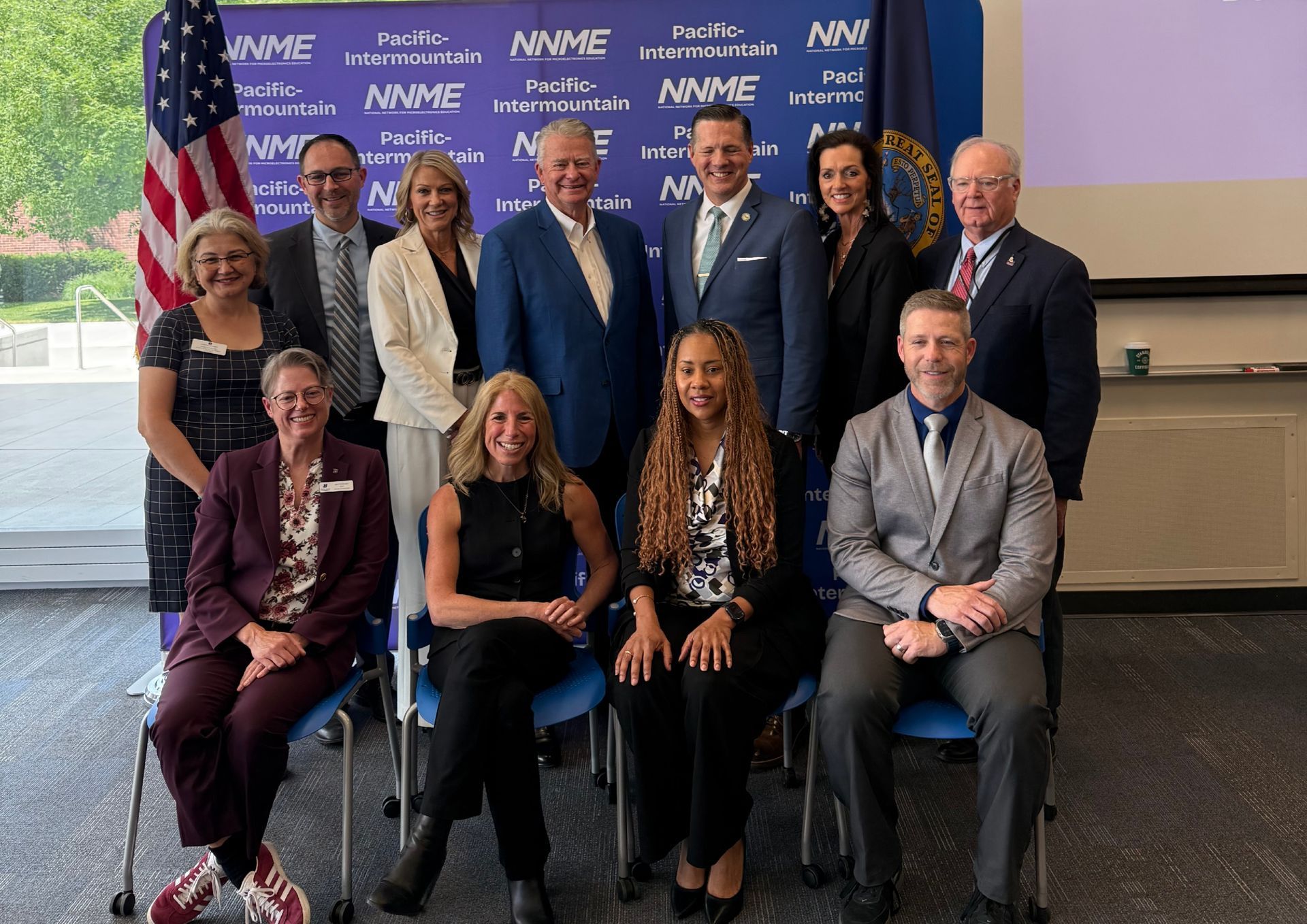
This morning at the Micron Center for Materials Research on the Boise State University campus, Idaho made history. Boise State University was officially announced as the lead institution for the NNME Pacific Intermountain — one of the first four Regional Nodes of the National Network for Microelectronics Education. The Idaho Technology Council is proud to be a named partner.
What Is the NNME — and Why Does It Matter for Idaho?
The NNME is America's answer to one of the defining economic challenges of our time. A recent McKinsey study found that the U.S. semiconductor industry will need between 127,000 and 157,000 additional workers by 2030. The CHIPS and Science Act accelerated investment in domestic manufacturing — but investment alone doesn't build the workforce. That is what the NNME exists to do.
Funded by the U.S. National Science Foundation Directorate for Technology, Innovation, and Partnerships in partnership with the U.S. Department of Commerce, the NNME Pacific Intermountain node brings together 20 universities and nine community colleges across nine states — Idaho, Washington, Oregon, Montana, Utah, Colorado, Nevada, Northern California, and Hawaii — into a coordinated, industry-aligned talent pipeline.
Boise State, through its Microelectronics Education and Research Center (MERC), is one of only four institutions in the nation selected to lead a Regional Node. That is a significant designation.
Idaho's Place in the Semiconductor Economy
Idaho is not a bystander in the global semiconductor race. Micron Technology — one of the only DRAM manufacturers headquartered in the United States — is right here in the Treasure Valley. The region is poised for significant growth as new advanced manufacturing facilities come online, creating thousands of jobs and increasing demand for a highly trained workforce.
We are producing talent fast — just not nearly fast enough. This Regional Node changes that equation.
Who Was in the Room
Today's event drew an extraordinary group of national and state leaders to the Micron Center for Materials Research at Boise State University:
- Dr. Amy Fleischer Dean and Professor, College of Engineering, Boise State University — Emcee
- Dr. Nancy Glenn Acting President and Vice President of Research and Economic Development, Boise State University
- Governor Brad Little State of Idaho
- Brian Stone Chief of Staff performing the duties of Director, U.S. National Science Foundation
- April Arnzen Executive Vice President and Chief People Officer, Micron Technology
- Shari Liss Vice President of Global Workforce Development, SEMI Foundation
- Dr. Jennifer Ellis Director, National Network for Microelectronics Education
- Dr. Kurtis Cantley Director, Microelectronics Education and Research Center, Boise State University
- Diane Temple President & CEO, Idaho Technology Council
When historians look back at the rebuilding of America's semiconductor talent pipeline, Idaho will be in that story — not as a footnote, but as a leader.
— Diane Temple, President & CEO, Idaho Technology CouncilWhat ITC Is Bringing to This Work
The Idaho Technology Council is not simply a signatory to this effort. We are an active partner. As the statewide voice of Idaho's technology and tech-adjacent industries — with member companies across all 44 counties — we bring something the university system cannot build alone: direct industry connection.
Our commitment to NNME Pacific Intermountain is concrete:
- Connect job seekers to NNME training pathways
- Leverage our member company network to keep the program responsive to real employer needs
- Provide mentorship and wraparound support for students preparing for semiconductor careers
- Contribute mentor-mentee matching that helps students not only access training, but see themselves in a career they may not have known existed
Because workforce development is not just about curriculum. It is about connection.
The MERITS Alliance: Idaho's International Pipeline
There is one more dimension of today's announcement worth highlighting — because it signals where Idaho is headed next.
MERITS Alliance
The MERITS Alliance — Manufacturing, Education, Research for Idaho-Taiwan Success — is emerging as a subset of the PINES regional network. It connects Idaho institutions directly with Taiwan's advanced semiconductor ecosystem through research collaboration, student exchange, and employer-to-employer partnership.
In May, six MOUs were signed between Idaho institutions and Taiwanese partners at our "Invest in Idaho: From Potato Chips to Microchips" summit at the State Capitol. That was not ceremony. That was the foundation of an international pipeline — and it is just getting started.
Learn more at idahomerits.org →A Long-Term Commitment to Idaho
When historians look back at the rebuilding of America's semiconductor talent pipeline, Idaho will be in that story — not as a footnote, but as a leader.
Congratulations to Boise State University, Dr. Kurtis Cantley, Dr. Amy Fleischer, Dr. Nancy Glenn, and every partner who contributed to making today possible. We are proud to stand alongside the full PINES consortium as we work together to build the workforce, the partnerships, and the innovation ecosystem our future demands.