Protecting Yourself from Artificial Intelligence (AI)-Powered Imposter Scams – Tips from KeyBank

As artificial intelligence becomes more sophisticated and accessible, financial institutions are seeing a sharp rise in a new form of fraud: AI‑powered imposter scams. These schemes use advanced tools to convincingly mimic a person’s voice, image, or behavior, making them harder to spot and more emotionally manipulative than traditional scams.


KeyBank and other financial organizations are urging consumers to stay alert as criminals adopt these emerging technologies.


A New Twist on an Old Scam

Imposter scams have long been one of the most common forms of financial fraud, but AI has dramatically raised the stakes. Using publicly available voice clips, photos, or videos—often pulled from social media—fraudsters can now replicate a person’s speech patterns or even generate realistic videos known as “deepfakes.”


These tools allow criminals to pose as:

  • Family members in urgent distress
  • Friends requesting help
  • Bank representatives seeking account information


KeyBank will never call, email, or text asking for personal credentials such as your full Social Security number, online banking username, or password. Any unexpected request for sensitive details should be considered suspicious. If someone calls you asking for this information, hang up and call your bank through a known channel.


How AI-Driven Scams Work


Voice Cloning


Scammers use AI to analyze audio samples and recreate someone’s voice with startling accuracy. Once they have a convincing imitation, they may call victims claiming:

  • A family emergency that requires immediate financial help
  • An urgent need to “verify” account information
  • Cloned voices may sound real but often struggle with natural emotion, timing, or detailed personal questions.


Deepfake Videos


Deepfake technology allows scammers to generate hyper-realistic videos of people saying or doing things they never actually said or did. These videos may exhibit subtle flaws, such as:

  • Unnatural blinking
  • Odd shadows or lighting
  • Mismatched lip movements
  • Distorted backgrounds


Such content is often designed to create urgency or emotional pressure to extract money or information.


Warning Signs to Watch For

With voice calls, be cautious if:

  • The speech sounds slightly robotic or inconsistent
  • The caller cannot answer questions only the real person would know
  • There is pressure to act immediately

With videos, be alert for:

  • Stiff or unnatural facial movements
  • Odd lighting or blurry background details
  • Poorly synced audio and video
  • Watermarks indicating the content may have been flagged or altered on social platforms


How to Protect Yourself


Experts recommend several steps to reduce your risk:


  • Verify the request: If someone claims to need money or sensitive information, contact them back using a known, trusted phone number or communication channel.
  • Be wary of urgency: Scammers rely on panic. Slow down and double-check.
  • Enable multi-factor authentication wherever possible.
  • Limit personal information you share online, especially videos and audio clips.
  • Monitor your accounts daily and report unauthorized activity immediately.
  • Stay educated: Share fraud-prevention tips with family members, particularly older adults who may be targeted more frequently.


If You Suspect You’ve Been Targeted

  • Take swift action:
  • Contact any financial institution involved.
  • File a report with the Federal Trade Commission at IdentityTheft.gov.
  • Change passwords and security questions on affected accounts.
  • Consider placing a fraud alert on your credit reports and monitoring your credit closely.


Content provided for informational and educational purposes only and is in no way to be construed as financial, investment, or legal advice. We cannot and do not guarantee their applicability or accuracy in regards to your individual circumstances. All examples are hypothetical and are for illustrative purposes. We encourage you to seek personalized advice from qualified professionals regarding all personal financial issues. ©2026 KeyCorp®. All rights reserved. KeyBank Member FDIC New CFMA: #260319-4233128


About the Idaho Technology Council

The Idaho Technology Council is a membership organization committed to increasing awareness of a thriving technology ecosystem statewide. We are dedicated to fostering an innovative tech community in Idaho by acting as a catalyst that brings together leaders, drives collaboration across all industries, and advocates for tech growth. As a nucleus of thought leaders, innovation, and tech advocacy, we empower government, industry, and reinvestment. Our mission is to position Idaho as a premier tech destination by attracting tech companies and talent, driving educational support and policy, convening tech leadership, and initiating conversations on emerging topics. 


by Tim Munkres • 7 October 2026
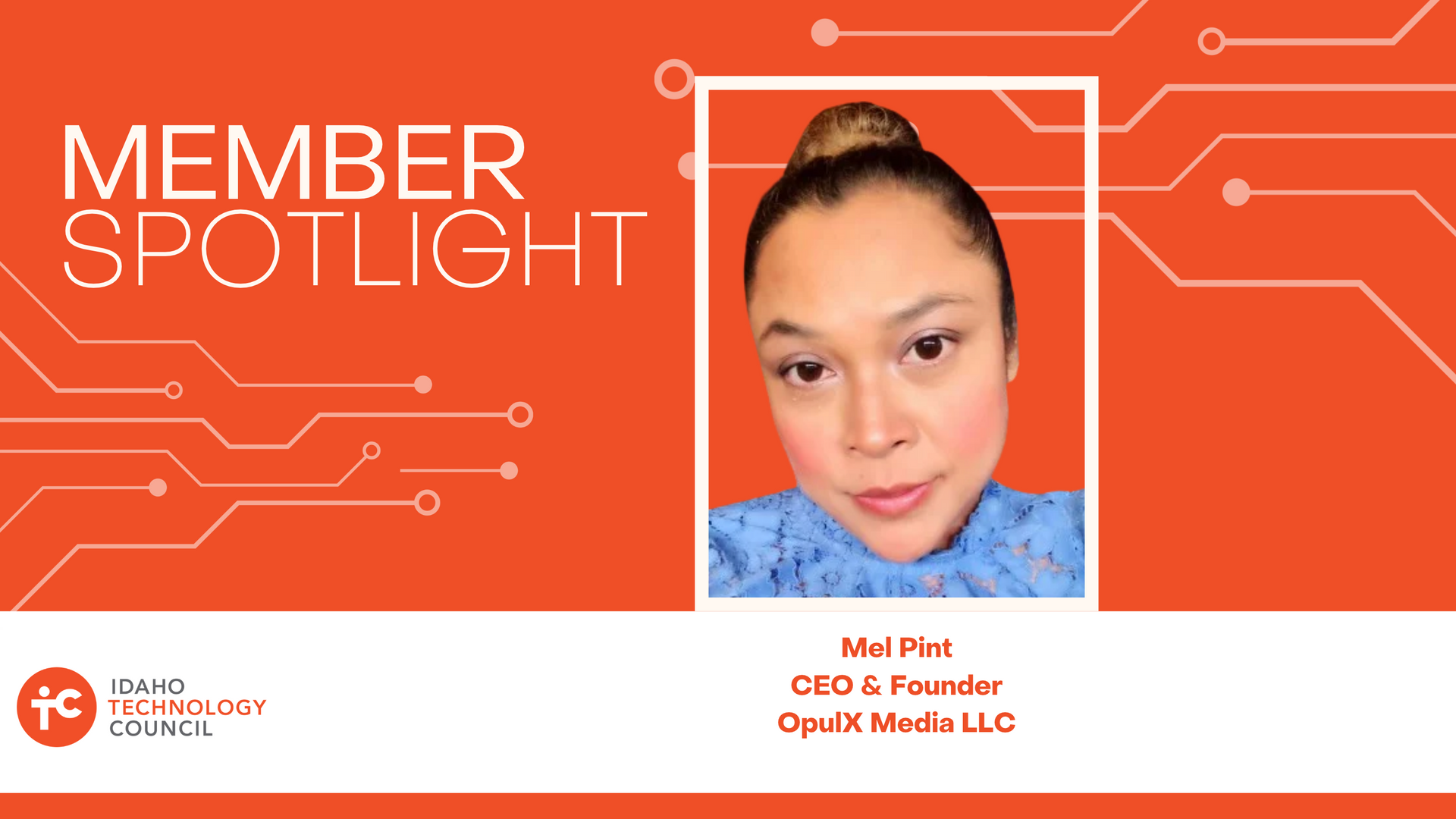
Introducing: Mel Pint, Founder & CEO, OpulX Media LLC Describe the business/organization you work for: OpulX Media LLC is an Idaho-registered live events company and a sister company of OpulenceX Inc., the marketplace where artists sell their work and keep earning royalties when it resells. OpulX Media produces art, fashion and technology showcases built around augmented reality and digital collectibles. Our first production is The Digital Loom: Intersecting Realities at Boise Centre on November 14, 2026: an AR runway, an exhibition of international artists whose every work is registered as a digital twin, and a free afternoon built around The Loom Youth Prize, a statewide art competition for Idaho kids and teens. It is planned as an annual Boise event, with a Honolulu edition in April 2027. What inspired you to start your own business, or why did you decide to work for this specific organization? I watched artists sell a piece once and never see another dollar from it, while the technology that fixes that already existed and nobody was putting it in front of the people who make things. OpulenceX Inc built the tools. OpulX Media exists because tools alone do not change anything; a room full of people watching a garment come alive through their own phone, standing next to a painting a nine-year-old made, does. Boise has a technology community, an arts community and a fashion community, and they rarely stand in the same room. I wanted to build the night where they do. What sets this business apart from others in the industry? Most media companies build audiences and rent them to advertisers. We build a creator economy and stand inside it with the creators. What challenges have you faced as a business owner or employee, and how did you overcome them? Being new. A first-year event with a technology company behind it has to earn standing in the arts community before anyone will put their name next to it. We did that the slow way: a venue contract before any letter went out, a judged youth prize with real cash and real exhibition space, terms for artists that put 70% of every sale in their hands. Joining the Idaho Technology Council was part of the same answer: be inside the community before asking anything of it. What advice would you give to someone looking to join your industry? Decide what you will not do before you decide what you will. Then find the person in your community who has done the hard part for years and ask them how, before you tell them what you are building. About the Idaho Technology Council The Idaho Technology Council (ITC) is a member-based organization that champions innovation and collaboration to grow Idaho’s economy through technology. Representing a dynamic and growing community of entrepreneurs, industry leaders, and policymakers, ITC connects vision with action to position Idaho as a hub for innovation and opportunity. Learn more at www.idahotechcouncil.org .  Connect with Mel Pint on LinkedIn HERE Learn More about OpulX Media HERE
by Tim Munkres • 10 September 2026
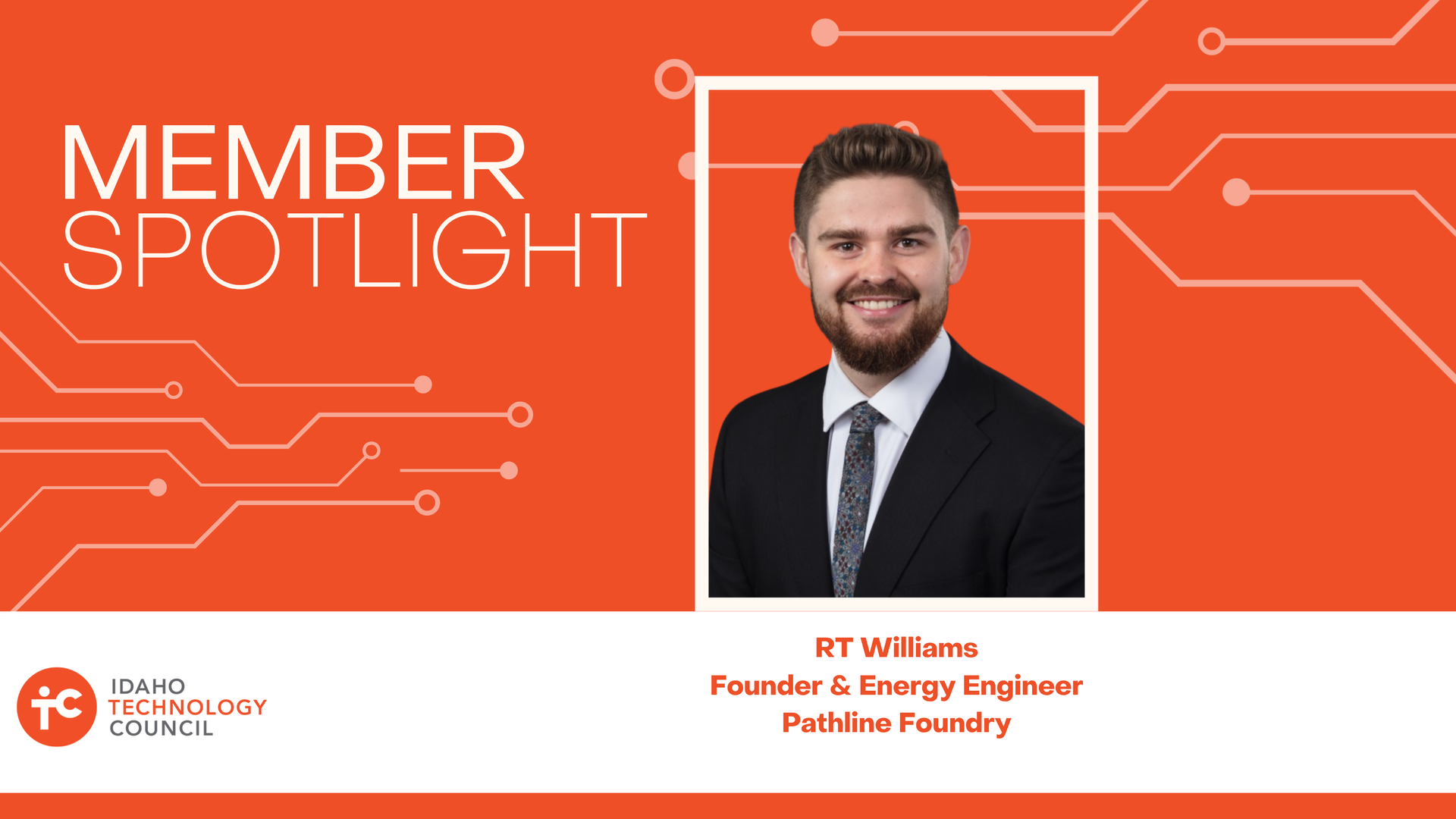
Introducing: RT Williams, Founder & Energy Engineer, Pathline Foundry Describe the business/organization you work for: Pathline Foundry is an independent energy consulting and software firm in Meridian, Idaho. I run the gamut from benchmarking and energy audits to custom software for energy strategy, management, and optimization. It's a niche offering that's widely applicable across many industries. One engineer, start to finish. See where your energy is going, so you can make a smarter decision about where it goes next. What inspired you to start your own business, or why did you decide to work for this specific organization? I want to be the person who stays and partners with those who need it most. I've been doing energy engineering since 2017, and I've kept seeing the same pattern. A building gets an audit report, the report goes on a shelf, and nothing changes. Pathline Foundry grew out of that pattern, and I build software for the same reason: the findings need somewhere to live once the engagement is over, or they end up back on the shelf. Energy gets treated as a fixed cost, a line on the bill you can't do anything about. It isn't. There's real money sitting in waste and inefficiency, and most of the people who could act on it have no spare bandwidth and limited technical staff. I wanted to make that easy to see and easy to act on. What sets this business apart from others in the industry? There's no sales team and no handoff to a junior analyst. You talk to the person doing the engineering, and that same person is still there when it comes time to implement. I build the software side myself too, so the analysis, the modeling, and the tools a client ends up using all come from one place. Where it fits, I take a share of the savings instead of a flat fee, so the work is built to pay for itself. I'm a PhD engineer and a Certified Energy Manager. I write the work so a decision-maker can understand it and an engineer can act on it. What challenges have you faced as a business owner or employee, and how did you overcome them? Starting a business in a state where nobody knows you is a slow problem, and there's no clever fix for it. My family and I moved here in 2025, and I spent a lot of that first year in rooms where I knew one person, or none. What surprised me is that it made the actual work better. I used to lead with what I found in a building. Now I ask what somebody is trying to decide first, because a room full of strangers teaches you quickly that nobody cares what you know until they know why it matters to them. That turns out to be most of the job. Idaho has been more welcoming than I expected. Almost everything I've built here started with someone making an introduction, and I look forward to growing my work to support the community that made room for me. What advice would you give to someone looking to join your industry? Go into the buildings. You can learn modeling and software anywhere, but you can't learn how a facility actually runs from a spreadsheet. Spend time with the people who operate it. They'll tell you things no data set contains, and more often than not, they already know where the waste is. About the Idaho Technology Council The Idaho Technology Council (ITC) is a member-based organization that champions innovation and collaboration to grow Idaho’s economy through technology. Representing a dynamic and growing community of entrepreneurs, industry leaders, and policymakers, ITC connects vision with action to position Idaho as a hub for innovation and opportunity. Learn more at www.idahotechcouncil.org . Connect with RT Williams on LinkedIn HERE Learn More about Pathline Foundry HERE
9 September 2026
Idaho Technology Council Announces 2026 Hall of Fame Inductees, Idavation™ Award Finalists and Keynote Speaker Gary Sorrentino, CIO, Zoom