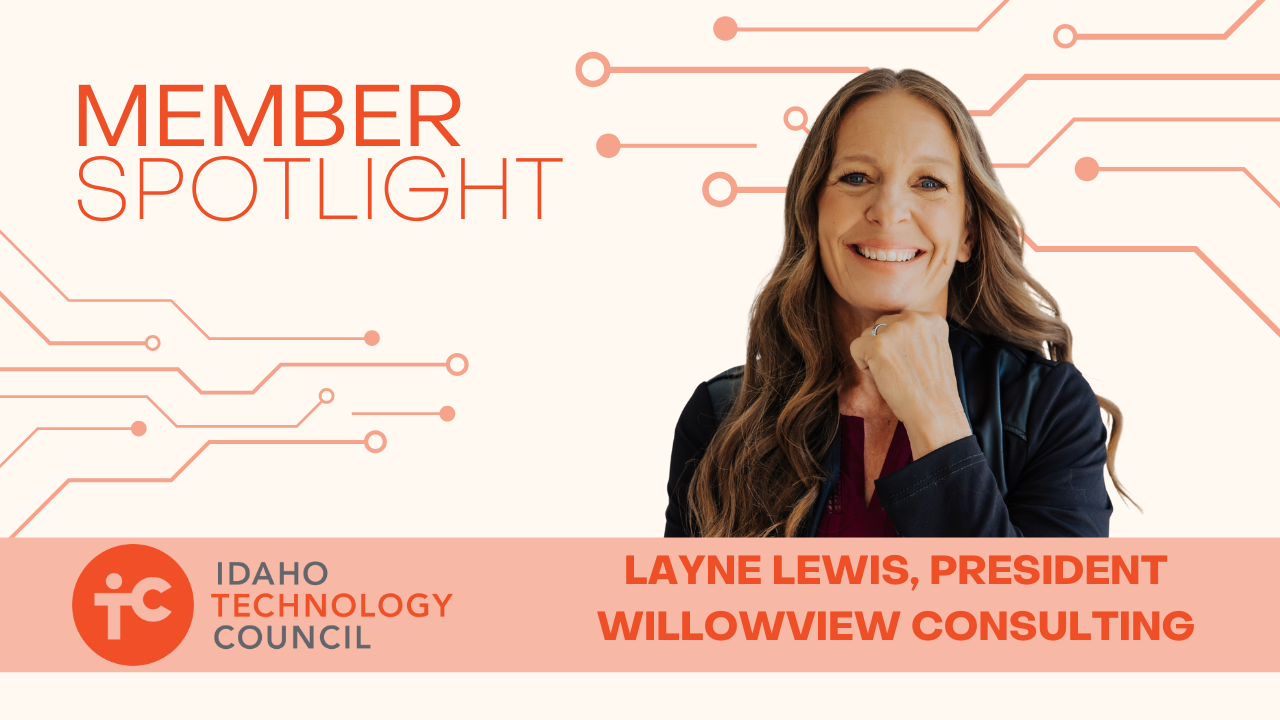
Layne is a member of the Idaho Technology Council

Introducing Layne Lewis, President, Willowview Consulting.


Describe the business/organization you work for

Founded in 2003 by Mrs. Layne Lewis, Willowview has worked hard to earn the trust of clients ranging from privately held large corporations to small technology start-up companies and large government agencies. Our team works with our clients to develop

innovative strategies and tactics to achieve success.


Our team offers “edge to app” engineering and product development services from ideation to deployment. We currently provide engineering solutions and program management to commercial companies in the United States and around the world. Our staff brings a wealth of experience from both the government and commercial arenas to

fully understand product definition, development, and acquisition processes.


We are highly skilled at solving technical problems efficiently through our “Just Enough” engineering methodology and an agile engineering approach – together with rapid prototyping – we’ll get the right solution into customer’s hands quickly and at

lower cost. 


Our staff has a diverse background and education. Our team includes previous Special Operations Forces Operators; Aerospace, Mechanical, Electrical and Systems Engineers; Computer Science and Information Systems experts, as well as Data Scientists and

Programmers.


What inspired you to start your own business, or why did you decide to work for this specific

organization?

From a young age, I was fascinated by aerospace engineering and the vast frontiers of space. After graduating college with a degree in the field, my dream came true when I landed a role at Booz Allen Hamilton supporting NASA's Space Station Program.For the next nine years, I gained invaluable experience working as a systems engineer on some of NASA's most high-profile missions. I was based out of offices in Reston, VA, Houston, TX, and Huntsville, AL - getting up close to various NASA centers' operations and gaining diverse technical expertise. When tragedy struck and I lost my father in 1993, it prompted deep reflection on my priorities. By that point married with two young sons, I realized I wanted a career path allowing greater personal relevance. We moved to Idaho in 1995 so I could join Hewlett-Packard, hoping for a better work-life fit. However, at HP I found myself performing repetitive tasks that failed to fulfill my entrepreneurial spirit. Determined to work at my own pace, I pursued an MBA with HP's sponsorship. I co-founded her first company in 2002 and rediscovered the gratification of pushing boundaries through innovation - igniting my drive as a businesswoman committed to enabling progress both professionally and personally for others. I have become a serial entrepreneur, starting 7 companies - clearly, it's in my blood!


What sets this business apart from others in the industry?

Our ability to work with very diverse customers - those who understand the technologies being evaluated, and those who do not - to distill very hard tech and complex issues into manageable projects, and to deliver rapid prototypes of solutions is a formidable task, and one that we excel at. For both government and commercial clients, we are trusted with a hard problem set, a budget and a timeline - and we do not fail to deliver.


What challenges have you faced as a business owner or employee, and how did you overcome them?

Ha! SO many! 2020 and COVID was an absolute joy (said no one ever!). One of our clients called me and told me he was going to stop paying me and I needed to still do the work for him but I could use the "government paycheck protection funds". What - what? that taught me a lot - how to manage through intense fear and stress, how to hold to my ethical lines, and how to work more effectively as a team. I remember bringing all of the employees into the conversations during that year, where we had to make some very hard decisions, and realizing that we were all in this together so we could all add value to the discussions-I did not have to do it all alone as the CEO. It made all of the difference, and we evolved as an even stronger team on the other side!


What advice would you give to someone looking to join your industry?

Come on, let's go! Working to solve hard problems is the most fun job ever!! I love my job and encourage anyone who is interested to shadow an engineer for a day!


Connect with Layne on LinkedIn HERE

Check out Willowview Consulting on their website HERE

by Rich Raimondi 23 April 2026
HP Boise’s incredible impact: How HP helped start the technology industry here in Idaho Boise, Idaho : While the company’s departure marks the end of an incredible era, the real credit and gratitude for HP’s success and lasting impact goes to its employees, writes - Rich Raimondi. Idaho Technology Council Founding Board Chair, 2024 ITC Hall of Fame Inductee Upon hearing of HP’s impending departure from Boise after 53 years, I, along with thousands of other former HP employees, were very saddened. We feel for the 1,100 current employees, their families and our community at large. We wish them all the best in determining what is next in their lives now that HP is closing down the site in 2027. But rather than dwell on feeling sad or angry, I would like to speak to and celebrate the incredible impact HP has had on Boise, the Treasure Valley and the state of Idaho over the past 53 years. In so many ways, we have been incredibly fortunate and blessed that HP chose to come to Boise in 1973. In reflecting on this and talking with former HP colleagues, I would cite five areas of impact HP had in its five decade history here in Boise. First, HP started the technology industry in Boise and Idaho. Without HP and Micron, which was founded four years later, there might not be a tech sector in Idaho. In addition to HP’s contributions, there is an Idaho tech ecosystem graphic that shows numerous companies that were founded by former HP employees, many of which grew to employ hundreds and helped shape entire industries. Companies like Extended Systems, Cradlepoint, ProClarity, White Cloud Analytics, Alturas and many others. Also, partly because of HP Boise’s success and the talent in the Boise area, other tech companies from throughout the west chose to move to Idaho. Finally, the impact over those five decades on the state GDP, employment and revenue base has been very significant. The second impact was the fact that HP brought thousands of talented people to Boise from across the country and the world. World-class business leaders, engineers, scientists and professionals in manufacturing, supply chain, marketing, finance and HR came to work for HP Boise. In particular, executives like Ray Smelek, Dick Hackborn, Don Curtis, Doug Carnahan, Rick Belluzzo, George Mulhern, Nor Rae Spohn, Cathy Lyons, Neil Martini, Carolyn Ticknor and Von Hansen all moved here to work for HP and made a significant impact by growing HP businesses and technologies — and employment — in Boise. They and hundreds of employees also made a difference in their communities by getting involved in nonprofits, universities and other businesses. They served on boards, on governmental task forces, as adjunct professors, as volunteers, and gave generously of their time, talent and treasure to numerous nonprofits. And, after they retired or left the company, most HP employees chose to remain living in Boise because they loved this community and the state of Idaho. My wife, Georgiann, and I were one of those who came in 1979 thinking we would be here for two to three years and then move back to Northern California where we were raised, our families lived and HP had large operations. But 47 years later, 30 of those with HP, we are still here. We, like so many others, found fulfilling careers, a wonderful community and chose to raise our family here. The third impact HP had was to provide thousands of jobs for Idahoans. People found fulfilling lifelong careers in a company that valued them and their contributions. Plus, Idaho university grads could stay at home and find challenging jobs and careers at a world-class company like HP. At its peak during the 1980s and 1990s, HP employed over 7,000 people at the Boise site. The fourth impact HP had was its special, unique and successful culture — “The HP Way.” The company was featured in books like “Good to Great,” largely because of the success of its culture which was embraced and lived by employees at all levels. The key elements of “The HP Way” were: 1) we have trust and respect for individuals; 2) we focus on a high level of achievement and contribution; 3) we conduct our business with uncompromising integrity; 4) we achieve our common objectives through teamwork; 5) we encourage flexibility and innovation. Also, HP practices like management by objectives, open door policies, management by walking around and profit-sharing were uncommon before HP. These values and practices impacted many other businesses and organizations in Idaho who developed similar cultures and practices. HP also provided leadership in areas that aligned with its core values, such as human rights. In the 1990s, HP established the Idaho Human Rights Award, in partnership with the Wassmuth Center for Human Rights, recognizing leaders in Idaho’s Treasure Valley who actively promoted respect, dignity, and human rights. Finally, the HP Boise team “saved HP” during a very turbulent time in the company’s history with the introduction of the first LaserJet printer in 1984. The LaserJet is often cited as the most successful product in HP’s long history and continues to be a cornerstone of HP’s business today. During LaserJet division reviews, HP Boise and the LaserJet product were called by various HP Board members and leaders “the lifeboat of HP” during the 1990s when all other parts of the company were struggling. It generated some 70% of the company’s profits and almost all of its growth for several years during that period. In summary, Boise, the state of Idaho and HP were blessed beyond all expectations by Ray Smelek’s recommendation in 1973 to HP’s founders, Bill Hewlett and Dave Packard, to establish an operation in Boise. While the company’s departure marks the end of an incredible era, the real credit and gratitude for HP’s success and lasting impact here in Boise goes to the tens of thousands of former and current HP employees who made such meaningful contributions to HP, HP Boise and the Boise community over the past 53 years. About Rich Raimondi Richard Raimondi spent 30 years at HP, 16 as a VP/SVP in several businesses inside HP. After retiring in 2008, he served as president of Bishop Kelly for 12 years. He currently serves on the boards of St. Luke’s Health System, LED, the Idaho Film Society, the Wassmuth Center for Human Rights and the College of Idaho Advisory Council. He was the founding chair of the Idaho Technology Council from 2010-2015. Rich was born and raised in Sacramento, California. He graduated from Stanford University in 1974 with a BA in history and has an MBA from the University of Oregon. About the Idaho Technology Council The Idaho Technology Council (ITC) is a member-based organization that champions innovation and collaboration to grow Idaho’s economy through technology. Representing a dynamic and growing community of entrepreneurs, industry leaders, and policymakers, ITC connects vision with action to position Idaho as a hub forinnovation and opportunity. Learn more at www.idahotechcouncil.org .
by Tim Munkres 7 April 2026
Introducing: Kevin Phithak, Staff Program Manager/Workforce Strategies, Micron Technology Describe the business/organization you work for: Micron Technology is a world leader in innovating memory and storage solutions that accelerate the transformation of information into intelligence, inspiring the world to learn, communicate and advance faster than ever. What inspired you to start your own business, or why did you decide to work for this specific organization? Growing up, my dad worked at Micron, and some of my favorite memories were attending the company picnics. Those events offered a chance to connect with the community, enjoy great food and activities, and even tour the fab in a cleanroom suit. Experiencing that environment at a young age sparked my interest in technology and inspired me to pursue a career in a high?tech company. Today, both of my brothers and I are proud to be second?generation Micron team members. I truly value the diverse and meaningful challenges I get to work on here—especially the opportunity to inspire students to explore careers in our industry. It’s rewarding to contribute to work that has impact and helps shape the future talent pipeline. What sets this business apart from others in the industry? The semiconductor industry is a fast?paced, continuously evolving field that presents both exciting opportunities and unique challenges. It offers the chance to work with some of the most advanced and innovative technologies—capabilities you simply won’t encounter anywhere else. What challenges have you faced as a business owner or employee, and how did you overcome them? One of my biggest early challenges was developing a deep understanding of the CTE and community college programs that prepared students for technician roles. I needed to identify which schools offered relevant curricula, determine how their programs aligned with our team’s requirements, and figure out the best way to connect and build relationships with the right stakeholders. Much of this work involved navigating each institution’s structure to determine the appropriate point of contact—whether a department chair, dean, or career counselor. Through consistent outreach and experimentation with different engagement approaches, I ultimately created a reliable system for establishing those connections. After two years of focused effort, we have built a strong network of partner schools that now serve as a pipeline for technician talent. This foundation has significantly strengthened our ability to identify, engage, and recruit students into opportunities at Micron. What advice would you give to someone looking to join your industry? Maintain a growth mindset and remain open to continuous learning. Remember that a “no” is not the end of your path—it often simply redirects you toward new opportunities. About the Idaho Technology Council The Idaho Technology Council (ITC) is a member-based organization that champions innovation and collaboration to grow Idaho’s economy through technology. Representing a dynamic and growing community of entrepreneurs, industry leaders, and policymakers, ITC connects vision with action to position Idaho as a hub for innovation and opportunity. Learn more at www.idahotechcouncil.org . Connect with Kevin on LinkedIn HERE Check out Micron Technology HERE
by Diane Temple 27 March 2026
Idaho Advances AI in Education with Landmark Legislation, Strengthening Future Workforce Pipeline