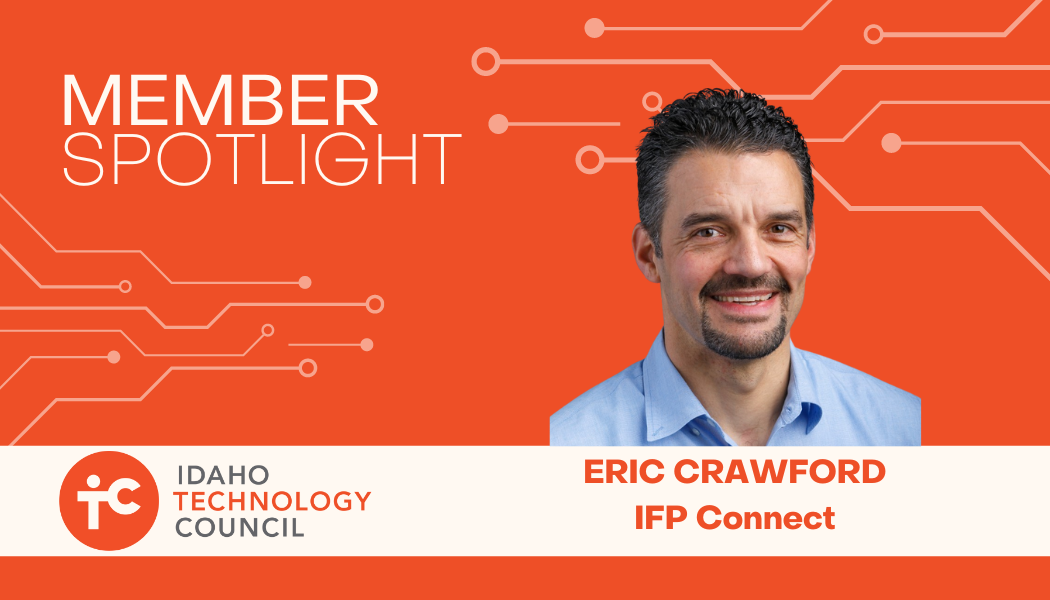
Eric crawford is a member of the idaho technology council

Introducing Eric Crawford from IFP Connect, an organization that manufactures patented fiberoptic hardware that revolutionizes how buildings are wired for data networks. As the name suggests, Integrated Fiber Platform’s hardware allows buildings to be wired entirely with fiber instead of copper for data networks, reducing costs, improving performance, and increasing efficiency. Their patented transceivers install in less time and deliver a lower cost than traditional copper category cable and connectors. IFP Connect’s products allow architects, builders, and building owners to deliver a better data network at the same or lower cost. Crawford, as the CEO, is a former low voltage contractor and engineer, and uses these past responsibilities to revolutionize how buildings are wired!


Email: eric.crawford@ifpconnect.com

Website: https://ifpconnect.com/


More on Eric and IFP Connect…


Describe your organization:


We manufacture patented products that revolutionize the data networks within a building by allowing them to be wired with fiber instead of copper, saving time and money, while delivering a better solution to the customer. We just received our first of four patents this month, and are excited to get in front of more trades to show them the value of using fiber instead of copper for their data and computer networks.


What inspired you to start your own business?


This is the second business I started. The first one was a smart home company that served high end residential and light commercial around the Treasure Valley. I sold that business in 2023 to launch IFP Connect, because the data networking industry needs a modern solution to address the vast limitations of category cable.


What sets your business apart from others in your industry?


We are the only company manufacturing products that allow buildings to be wired entirely with fiber, allowing the building to support the network needs of tomorrow.


What challenges have you faced as a new business owner, and how did you overcome them?


I am an operations guy through and through, so I am having a hard time developing sales channels and a customer base. Although I am capable of doing it, it is not my superpower like operations is.


What advice would you give to someone looking to start their own business?


However hard you think it will be, it is still harder. The emotional battles are deep, it is often lonely, and many times you have to make a decision with limited information. Starting a business is for those that want to go against the grain, want to tip over the apple cart, and are self-motivated, even in the presence of wide-spread doubt. The best part is that each day is 100% up to you. The worst part is that 100% of everything that happens with the company is your fault. However after 18 years in entrepreneurship, I don't think I could ever go back to a regular job.


Be sure to check out Eric using the social media links below. If you are interested in learning more about IFP, please check out their website or contact Eric using the email listed above.

by Diane Temple 18 February 2026
Healthy Ecosystems depend upon entrepreneurship.
by Tim Munkres 11 February 2026
Introducing: Aditya Ravindra, Enterprise AI & Analytics Expert, InterMountain AI Consultants Describe the business/organization you work for: InterMountain AI Consultants helps small and medium-sized businesses transform data chaos into competitive advantages. I specialize in sifting through complex details and compiling them into actionable insights—and no, it's not as boring as it sounds. Here's a real example from this week: A local Idaho-based moving and storage company was drowning in spreadsheets, unable to see their financial picture in realtime. I built them a custom financial dashboard that consolidates revenue, expenses, and profitability metrics into live visualizations they can access from any device. Now their leadership team makes data-driven decisions in minutes instead of spending hours digging through Excel files. The dashboard transforms their raw operational data into clear insights about which services are most profitable, seasonal trends, and cash flow patterns. Simply put: data talks, I listen, and I help business leaders join the conversation. What inspired you to start your own business, or why did you decide to work for this specific organization? Scope and impact. I currently work as a Senior Data Consultant at a Fortune 5 healthcare company, where every day presents new challenges at enterprise scale. While pursuing my Master's in AI from UT Austin, I've found it incredibly rewarding to apply cutting-edge theories to realworld problems. However, working within a large organization often means being channeled into specific projects. I wanted to branch out—to create customized solutions across diverse industries and help regional businesses access enterprise-level AI expertise. I need variety to thrive, and consulting allows me to bring Fortune 500 methodologies to local Idaho businesses who need them most. What sets this business apart from others in the industry? Continuous education and cutting through the AI hype. My approach isn't just about degrees and credentials—it's about staying on the cutting edge. I regularly complete the latest training workshops, AI certifications, and technical courses to understand what's actually emerging in AI versus what's just buzzwords. This knowledge lets me guide businesses toward practical, ROI-driven solutions rather than expensive experiments. I translate complex AI capabilities into business language and help leaders understand what will actually move the needle for their specific operations. Think of me as an AI translator who speaks both data science and business outcomes. What challenges have you faced as a business owner or employee, and how did you overcome them? The biggest challenge is navigating client fear and skepticism around AI. Many business leaders feel overwhelmed by AI hype or worry about implementation complexity. I've turned this into my superpower—I guide clients through the noise toward what's genuinely useful for their specific needs, distinguishing practical tools from empty promises. The second challenge is the "how"—designing the optimal customized solution from thousands of possible approaches. While sometimes overwhelming, this is also the most rewarding part. Each client's unique data environment requires creative problem-solving, and finding that perfect fit between their needs and the right AI tools keeps the work engaging. What advice would you give to someone looking to join your industry? Three pieces of advice: First, just start. Don't wait for perfect conditions—pick a course, open your laptop, and begin. We're at the ground floor of AI, and this opportunity won't last forever. Second, embrace failure as education. Not every approach will work, but each failure teaches you what will succeed next time. The projects that work best are often built on lessons from the ones that didn't. Third, find ways to make it fun. Every job has monotonous moments, but approaching AI problems creatively keeps both learning and application enjoyable. The intersection of curiosity, persistence, and practical application is where real value emerges. About the Idaho Technology Council The Idaho Technology Council (ITC) is a member-based organization that champions innovation and collaboration to grow Idaho’s economy through technology. Representing a dynamic and growing community of entrepreneurs, industry leaders, and policymakers, ITC connects vision with action to position Idaho as a hub for i nnovation and opportunity. Learn more at www.idahotechcouncil.org . Connect with Aditya on LinkedIn HERE Check out InterMountain AI Consultants HERE